Case study · Equity valuation
Adobe (ADBE): $314 a share against a $241 price
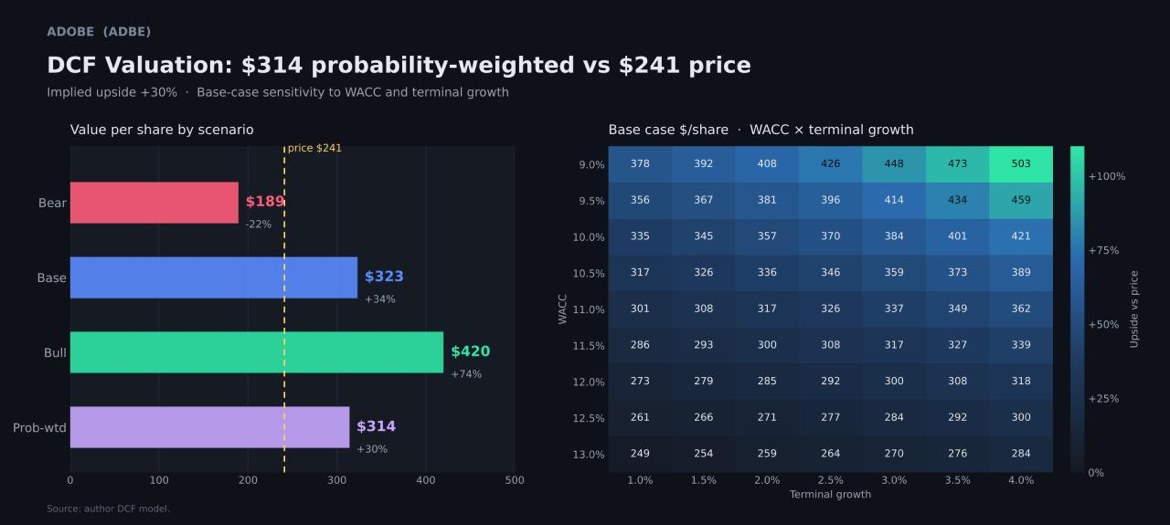
An automated Python DCF built from SEC EDGAR filings, with bear, base and bull scenarios and a reverse DCF. The probability-weighted value is 30% above the price at the time of the analysis, so I rated it a BUY.
$189
Bear case: 22% below the price
$323
Base case: 34% above
$420
Bull case: 74% above
$314
Probability-weighted: 30% above
Summary
What the price implies
I built a Python pipeline that pulls Adobe’s reported financials from SEC EDGAR, values the company under bear, base and bull scenarios and runs a reverse DCF.
The reverse DCF is the key result. At $241, the market is pricing in about 3% growth, while management guides to 12%. Weighting the three scenarios gives $314 a share, 30% above the price, so I issued a BUY.
The bear case is the honest counterweight: at $189 it sits 22% below the price. The base case holds up across its sensitivity grid: all 63 combinations of WACC (9–13%) and terminal growth (1–4%) value the shares above $241, from $249 to $503.
- Company
- Adobe Inc. (NASDAQ: ADBE)
- Rating
- BUY · $314 probability-weighted value vs $241 price
- Method
- Three-scenario DCF (WACC/CAPM), probability-weighted, plus a reverse DCF
- Data and tools
- SEC EDGAR filings pulled with Python (pandas); Excel
Model output
Value by scenario, and the base-case grid
Sensitivity
Base-case value per share: WACC × terminal growth
| WACC \ g | 1.0% | 1.5% | 2.0% | 2.5% | 3.0% | 3.5% | 4.0% |
|---|---|---|---|---|---|---|---|
| 9.0% | $378 | $392 | $408 | $426 | $448 | $473 | $503 |
| 9.5% | $356 | $367 | $381 | $396 | $414 | $434 | $459 |
| 10.0% | $335 | $345 | $357 | $370 | $384 | $401 | $421 |
| 10.5% | $317 | $326 | $336 | $346 | $359 | $373 | $389 |
| 11.0% | $301 | $308 | $317 | $326 | $337 | $349 | $362 |
| 11.5% | $286 | $293 | $300 | $308 | $317 | $327 | $339 |
| 12.0% | $273 | $279 | $285 | $292 | $300 | $308 | $318 |
| 12.5% | $261 | $266 | $271 | $277 | $284 | $292 | $300 |
| 13.0% | $249 | $254 | $259 | $264 | $270 | $276 | $284 |
Every cell is above the $241 price. Raising WACC from 9% to 13% cuts the value by 34–44%, depending on growth; raising terminal growth from 1% to 4% adds 14–33%. The discount rate moves this valuation more than growth does.
Method
How I built it
-
01
Pull the filings
A Python pipeline downloads Adobe’s reported financials from SEC EDGAR, so the model starts from the filings rather than a data vendor.
-
02
Value three scenarios
Bear, base and bull cases, each discounted to a value per share: $189, $323 and $420.
-
03
Weight and compare
A probability-weighted value of $314 against the $241 price: 30% implied upside, and a BUY.
-
04
Run it backwards
A reverse DCF solves for the growth the market price implies: about 3%, against management’s 12% guidance.
-
05
Stress-test the base case
A grid of WACC (9–13%) by terminal growth (1–4%) shows how far the base case moves with its two most sensitive inputs.
Want to go through the numbers?
Email me and I’ll walk you through the assumptions behind each scenario.